By Mittens Whiskerton · Updated October 15, 2026 · How we choose products
Product guide
Why a Motion-Activated Night Light Helps Senior Cats at Night
By Mittens Whiskerton · Last updated October 15, 2026
As an Amazon Associate we earn from qualifying purchases. Learn more
By Mittens Whiskerton · Updated October 15, 2026 · How we choose products
Product guide
By Mittens Whiskerton · Last updated October 15, 2026
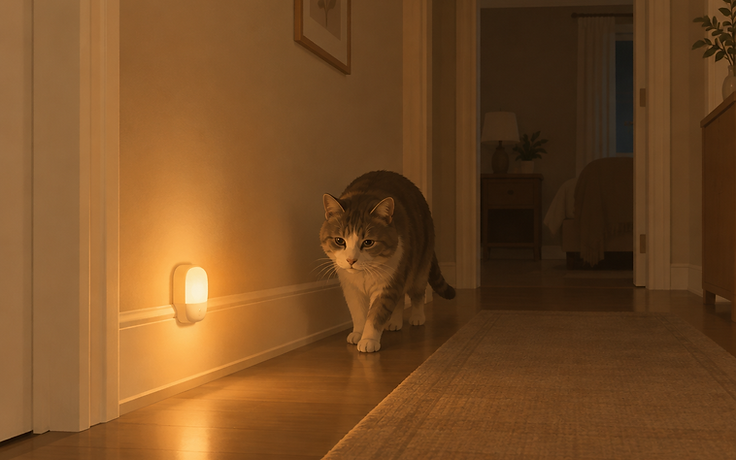
The short answer
A motion sensor night light is one of the simplest changes you can make for an older cat who moves around at night. Choose a warm amber glow rather than blue-white, mount it low enough to catch a cat crossing the floor, and position it along the route to the litter box.
Why we like it: A soft amber light that comes on as your cat approaches means they can find the box at night without feeling their way along the hallway in the dark.
Cats see less well in low light as they age, and a hallway that is easy in daylight can be genuinely confusing in the dark. You will often see more pacing, more meowing and more misses overnight. Lighting the route solves a surprising amount of it.
A warm amber or soft white glow, because harsh blue light is startling to older eyes. A sensor that triggers at low height, not only at human waist height. Multiple brightness settings so you can start dim and adjust.
One along the path from bed to litter box, and one near the box itself. Test by walking past at your cat’s height to confirm the sensor actually triggers. Keep the run short and even rather than bright and patchy.
As an Amazon Associate we earn from qualifying purchases. We focus on comfort, mobility and home setup and never make medical claims. Anything that looks like a sudden change in your cat's health should go to your vet, not to a product page.

Product guide
A high rim is one of the most common reasons an older cat starts going beside the box. Here is what to look for instead.
Read the guide
Guide
Simple, low-cost changes that help an older cat feel steady on hardwood and tile, starting today.
Read the guide
Product guide
A runner along the paths your cat walks is the least intrusive way to give back their footing, with nothing on their feet.
Read the guideNot sure where to start?
Matched to your cat, your floors and your home. It takes about a minute, and you can change your answers at any point.


